

Friday Night. Full Restaurant. Wrong Wine List.
Imagine it’s a busy Friday evening.
The dining room is full. The kitchen is flying. Guests are ordering wine with nearly every table.
It feels like a good night.
Then you look at the figures on Monday morning and discover something surprising:
Your best-selling wine made less money than three other wines that sold half as often.
We see this more often than you might think.
Many venues focus so heavily on what sells that they forget to ask a second question:
What actually makes money?
That’s where wine list GP comes in.
What Is Wine List GP?
GP stands for Gross Profit.
Put simply, it tells you how much money is left after the wine itself has been paid for.
If a bottle costs £8 and generates £12 profit after VAT is removed, that £12 is your GP.
The important thing is that GP allows you to compare wines properly. Without it, you’re often making pricing decisions based on gut feeling.
Why Does GP Matter More Than Markup?
A surprising number of operators still think in terms of multipliers: Three times cost. Four times cost. Five times cost.
The problem is that customers don’t buy using multipliers. They buy using prices.
Let’s look at two wines:
Wine A:
Cost Price: £7.00
Selling Price: £24.00
GP: £17.00
Wine B:
Cost Price: £12.00
Selling Price: £34.00
GP: £22.00
Many operators immediately focus on the percentage margin. The better question is:
Which wine contributes more pounds to the business each time it’s sold?
That’s the number that pays wages, energy bills and rent.
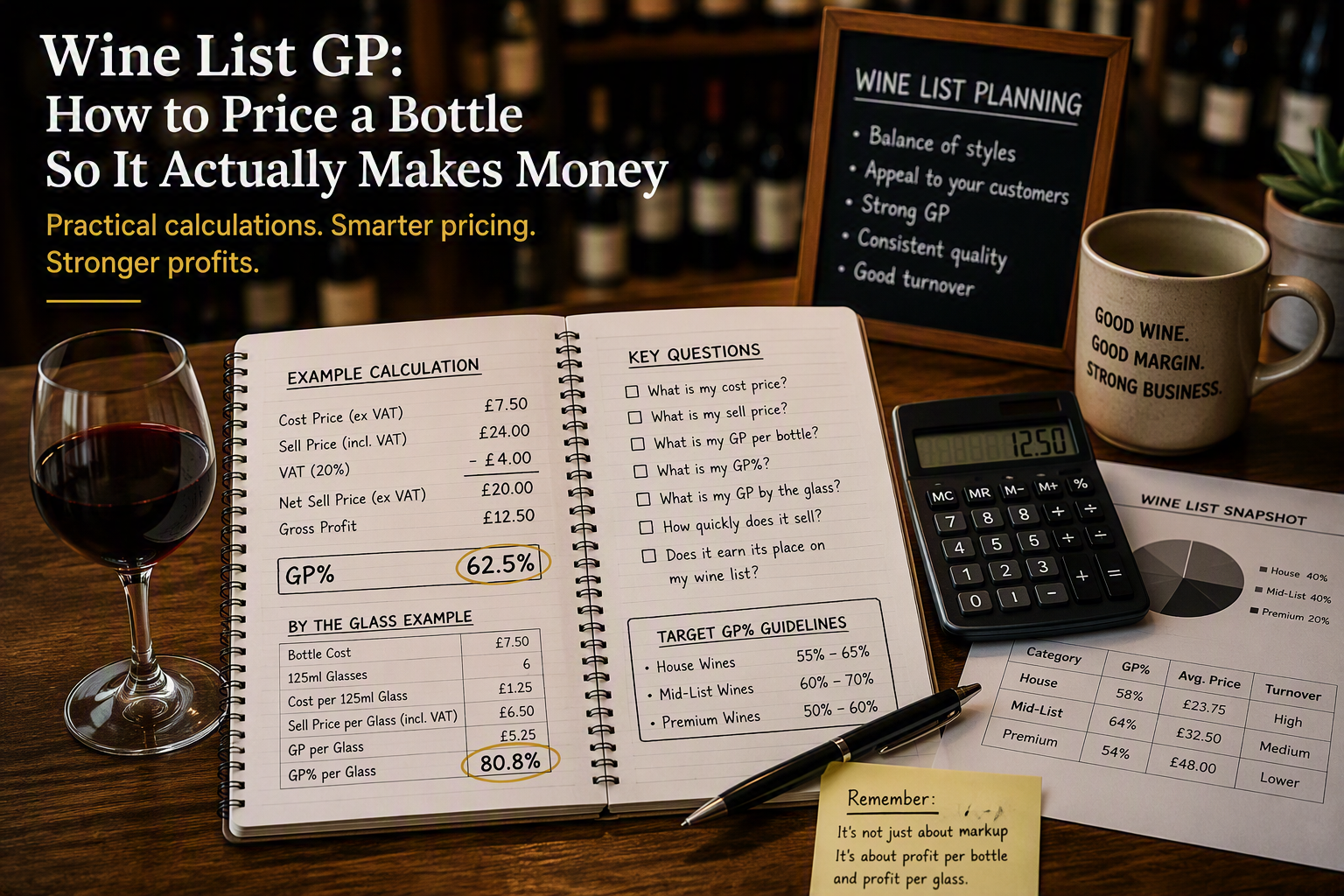
The Calculation Every Venue Should Know
Here’s a simple example:
Selling Price: £24.00
VAT: £4.00
Net Selling Price: £20.00 (Selling Price – VAT)
Cost Price: £8.00
Gross Profit: £12.00
So, your GP Percentage is:
(Gross Profit ÷ Net Selling Price) × 100
or
(£12.00 ÷ £20.00) × 100 = 60%
Now compare that with another wine:
Selling Price: £29.00
VAT: £4.83
Net Selling Price: £24.17 (Selling Price – VAT)
Cost Price: £9.00
Gross Profit: £15.17
So, your GP Percentage on this wine is:
(£15.17 ÷ £24.17) × 100 = 62.8%
The second wine generates over £3 more GP every time it’s sold. Across hundreds of bottles per year, that quickly becomes significant.
The Most Common Mistake We See
Many venues price wine according to what the restaurant down the road charges.
It’s understandable. Nobody wants to look expensive. But it can cause problems.
A venue in Aberdeen city centre, a hotel in Royal Deeside and a seafood restaurant in Stonehaven may all have completely different customers, operating costs and wine sales patterns.
The “correct” selling price for one venue is not automatically the correct selling price for another.
What Makes A Wine List Profitable?
Interestingly, it is not always the wines people assume. The strongest-performing wine lists tend to have:
• House wines that move consistently
• Mid-list wines that encourage trade-up
• Premium wines that generate strong GP per bottle
Plus:
• A few by-the-glass options staff can confidently recommend
In other words:
Not too many options. Not too few.
Just enough.
Why By-The-Glass Can Change Everything
Take a £7.50 bottle.
Sold by the bottle, it might generate:
£12.50 GP
Sold by the glass:
£20.00 GP
The same wine. The same bottle. Very different outcome.
This is why by-the-glass strategy is often more important than operators realise.
What Sells In North East Scotland?
There is no universal answer, which is exactly the point.
An independent seafood restaurant serving Peterhead langoustines will often see different buying behaviour from a city-centre grill or a rural gastropub.
That’s why we always encourage venues to look at their own figures rather than industry averages.
Your numbers normally tell a more useful story.
Three Questions To Ask Every Wine On Your List:
Next time you review the wine list, ask:
Does It Sell? Does It Make Money?
Check the actual GP. Would You Miss It?
If that wine disappeared tomorrow, would customers notice? Would staff notice?
Would profits change?
You would be surprised how many slow-moving wines fail that test.
The Hidden Cost Of “Playing It Safe”
One of the most expensive decisions a venue can make is leaving a wine list unchanged for years.
Costs rise. Wages rise. Utilities rise. Supplier costs change.
But many wine prices stay exactly where they were.
The result isn’t usually customer happiness.
It’s eroded GP.
Small, regular reviews tend to work better than one large correction every few years.
The Goal Isn’t The Highest GP
This is important.
The objective is not to create the highest GP percentage possible.
The objective is to create a wine list that:
• Sells well
• Makes money
• Works for your customers
• Compliments the food you’re offering
The best wine lists balance all four.
Final Thoughts
The most profitable wine on your list is not always the most expensive, nor is it always the best-selling.
The only way to know is to look at the numbers.
A basic GP review can reveal opportunities that have been hiding in plain sight for years, and sometimes a small change to pricing, list structure or by-the-glass selection can have a bigger impact than introducing ten new wines.